
New joint Group of Surfaces and Thin Films established
Two complementary surface-physics teams of the KFPP department are joining their forces in a single research group.
We combine atomic-scale microscopy, electron and vibrational spectroscopy, thin-film growth and model reactivity to understand surfaces, interfaces and materials in action.
Two complementary surface-physics teams of the KFPP department are joining their forces in a single research group.
Open opportunities connected with current ERC, EIC and surface-science projects.

A visiting PhD student from Jagiellonian University joined the group to work on ferroelectric perovskites.

Visiting Master student Ugo worked on prototype lithium-niobate sensors for scanning probe microscopy.

Sreehari Sreekumar was awarded the 🏆 Young Researcher Presentation Prize (Runner-up) at ECOSS 2026 in Oslo for the "Best Scientific Talk".

Our group joined the EIC-funded FAST consortium on Functionalised Activated Sapphire Thin-disks.

Our cooperative work gave an explanation to the long-lasting controversy around origins of reactivity of h-BN and other boron-based catalysts.

A new paper demonstrates real-space tracking of polarons by STM/AFM.
Our methods span the pressure, temperature and length scales needed to link atomic structure to real materials behaviour.
We image and manipulate atoms, molecules and localized charges using STM, nc-AFM and Kelvin-probe methods, from room temperature to cryogenic conditions.
Read more →
Well-defined surfaces and nanoparticles let us identify active sites and follow reaction mechanisms in gas-phase catalysis and electrochemical environments.
Read more →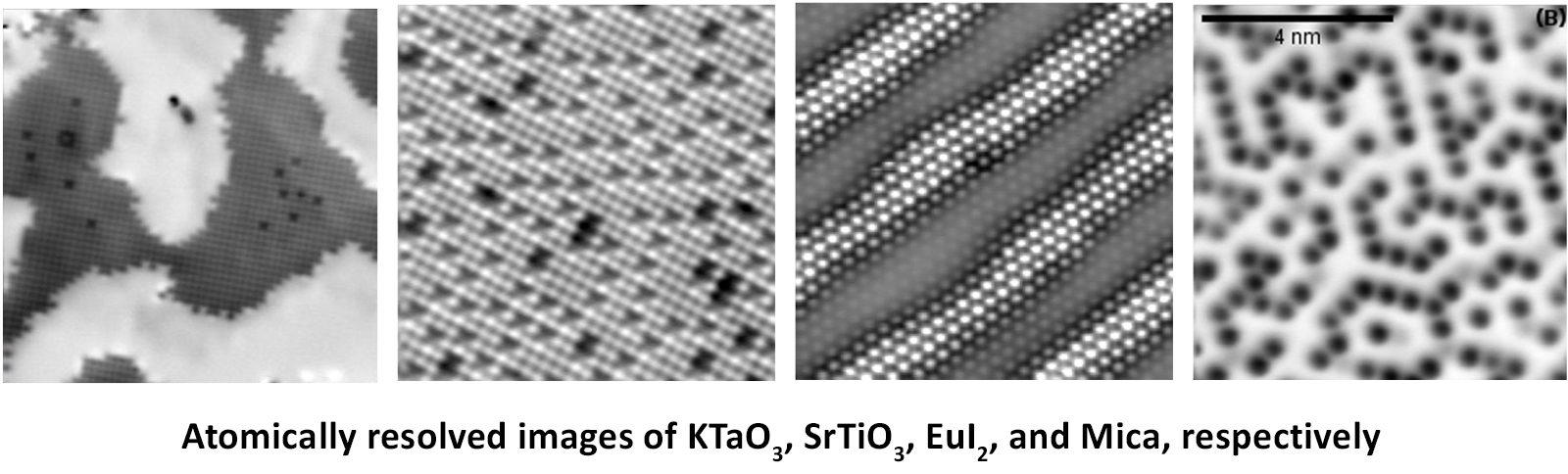
Perovskites, polar surfaces, ionic crystals and functional oxides provide a platform for studying charge localization, reconstruction and emergent electronic states.
Read more →
We prepare and study thin films, atomic nanostructures and two-dimensional assemblies using PVD, sputtering and kinetic modelling.
Read more →
XPS, TPD, FTIR/RAIRS/DRIFTS and mass spectrometry techniques allow to explore links between surface composition and adsorption, reactivity and stability.
Read more →
We investigate single atoms and organic molecules on silicon and other substrates, including self-assembly into low-dimensional structures.
Read more →Student projects and research positions are separated so you can immediately find the route into the group relevant for you.
Undergraduate students in the bachelor study programme are welcome to chose on of the numerous topics we offer for their bachelor thesis.
Details →Undergraduate students in the master study programme are welcome to chose on of the numerous topics we offer for their master thesis.
Details →For those undergraduate students who would like to participate at real-life scientific topics, gain unique experience, and also get awarded financially, Student Faculty Grants (SFG) are open for application from October 15, 2024 till November 15, 2024.
Details →Students of the Bc. programme in physics are encouraged to get acquaint with our daily laboratory work through their own hands-on experience. These short-term projects are conveniently scheduled for the summer break not to collide with other study duties.
Details →We offer a fully-funded post-doc position which is to be involved in mostly experimental research of novel materials suitable for interesting surface-related phenomena, namely in heterogeneous catalysis, electrochemistry and sensing. The applicant’s research will focus mainly on so-called model studies of multicomponent materials based on reducible oxides and metallic or bimetallic nanostructures and thin films, with potential extension to more complex structures and environments.
Details →Computer simulations, code optimization and data processing for thin-film growth.
Details →Cryogenic STM/AFM research focused on polarons and ionic materials.
Details →