Vedoucí: Gilbert Pi, Ph.D.
Stav projektu: volný
Anotace:
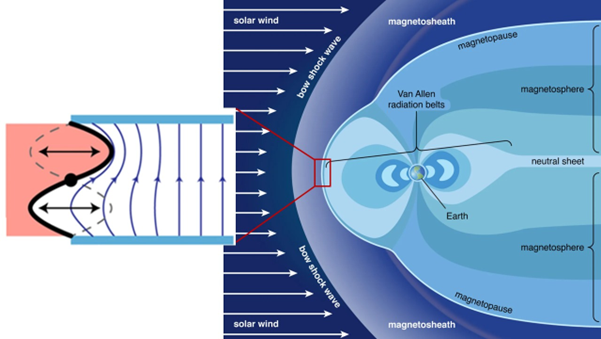
The Sun continues to emit not only light but also the "Wind," known as the solar wind, which includes plasma with a magnetic field. When the solar wind encounters the Earth's magnetosphere, the magnetopause forms and adjusts its position and shape in response to upstream solar wind conditions. The magnetopause motion can be separated into two categories: global expansion (compression) and local oscillations. This project will investigate magnetopause motion and oscillations, an active research field with broader implications for energy transport into the magnetosphere. While the magnetopause position is primarily determined by the balance of pressures, its motion is often more complex than simple global compression, involving features like large-scale vortices. The project aims to characterize the oscillatory behavior of this boundary, specifically on the dayside, to determine how the subsolar region and the dawn/dusk flanks differ and how these motions correlate with the upstream conditions. The student will utilize a massive, pre-existing database of over 50,000 magnetopause crossing events recorded by satellite missions such as THEMIS and MMS. By processing these experimental data using IDL or Python, the project will involve calculating oscillation frequencies from single-satellite multiple crossings and estimating maximum amplitudes from multi-satellite observations to provide a physical interpretation of the results.